



2020-10-11
|The NETWORK
|Source: www.swissinfo.ch
Tara Giroud
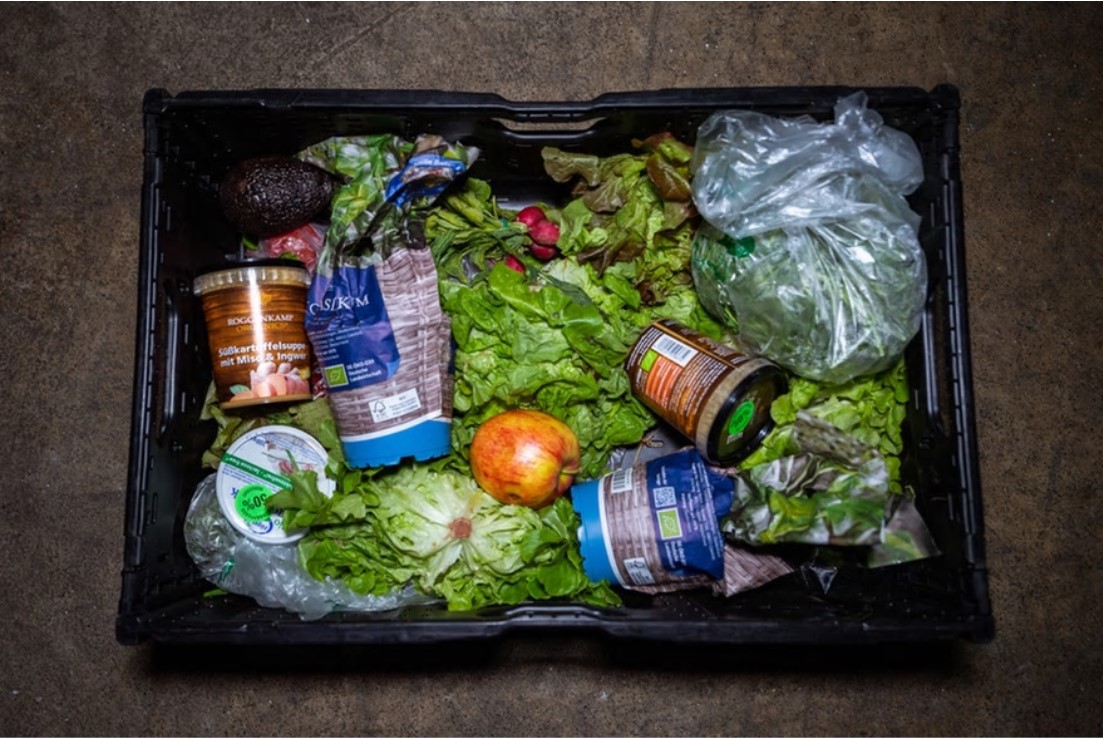
Every year, around 1.3 billion tonnes of food goes to waste worldwide. In Switzerland researchers are trying to help tackle the food waste challenge using nanotechnology.
It can happen to anyone - a yogurt at the back of your refrigerator has passed its best-before date and you end up throwing it in the garbage or compost. But was it actually ok to eat?
The best-before quality recommendation stamped on food can be confusing for consumers. Perhaps the food in that particular package was perfectly safe and tasty. And by ending up in the bin unnecessarily, it simply added to the mountains of food waste.
According to the Food and Agriculture Organization of the United Nations (FAO), roughly one-third of all food produced every year is wasted or lost from farms to shops to caterers to households. Switzerland is a major culprit: 190 kilos of food is wasted per person annually.
Niloufar Sharif believes she might have an answer to this problem. The Iranian post-doctoral researcher is working on a three-year project at the Federal Institute of Technology Lausanne (EPFL) to develop intelligent packaging technologies that can precisely identify which products are spoiled.
Carbon nanotubes
In her nanotechnology lab at the EPFL, Sharif is building sensors from miniscule carbon nanotubes, cylindrical molecules consisting of rolled-up sheets of single-layer carbon atoms measuring one billionth of a metre, which she hopes will be useful for detecting signs of food degradation.
These ultra-tiny sensors, integrated into food packaging, react when food goes off. A system then interprets the data and translates it into a sign people can read on the outside of the food package.
Different foods decompose in different ways, at various rates and under different conditions, such as light and moisture levels. Sharif believes her sensors can react to certain gases during bacterial or fungal activity on the food.
One way it can do this is by monitoring pH levels, which tell if something is acidic, neutral or alkaline, and can indicate food decomposition.
“If we have a product in which there is no microorganism activity, we may have, for example, a pH of 7 [which is in the middle or neutral],” Sharif said. “When we have activity of microorganisms, this pH will change. If this sensor detects changes of the pH, it alerts us to some kind of activity of microorganisms.”
If the pH moves into unsafe territory, a sensor on the label alerts food managers or shoppers that the food is no longer safe to eat. Sharif’s project was selected as part of the Future Food Initiative, a Swiss science-industry programme that aims to expand research and education in the area of food and nutrition.
Although her work has been delayed due to the coronavirus pandemic, she is now busy setting up the lab for the first of the project’s three phases: testing the sensors with various gases, integrating the sensors into packaging materials, and testing on actual food.
Ultra-small capsules
Another recent food waste project in Switzerland used nanotechnology to make smart packaging possible. It was completed in 2018 as part of Switzerland’s National Research Programme NRP 69, “Healthy Nutrition and Sustainable Food Production”.
In the University of Basel’s chemistry department, Professor Cornelia Gabriela Palivan and Ozana Fischer developed small glass surfaces to which they attached minuscule capsules, measuring just 100 nanometres in diameter, or 1,000th the width of a human hair.
The tiny capsules can be filled with different substances for various uses. The simplest, Palivan said, is as a reactor that can indicate when an environment has changed, such as when the quality of food deteriorates.With the sensors, “you will see a presence of specific molecules that are associated with food degradation,” she told swissinfo.ch.
Read the original story here.