


2020-08-24
|The NETWORK
|Source: www.rtbf.be
By Erik Dagonnier
Finding their breath and autonomy after intensive care is the goal of a COVID-19 recovery program offered to around thirty patients.
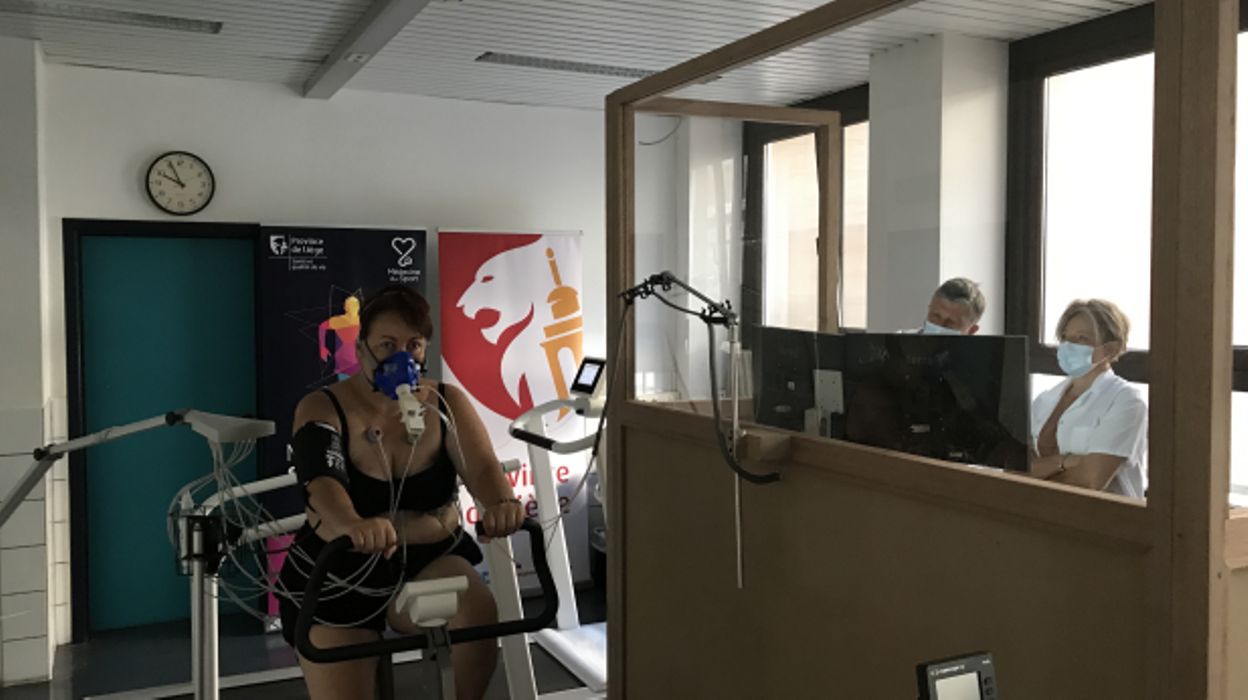
The sports medicine service of the Province of Liège, together with the CHU, studies the cardio-pulmonary and muscular capacities of patients after leaving the hospitals. They underwent tests comparable to those applied to top athletes.
A fitness program to regain your breath and independence
After infected by Covid-19, Jocelyne lived almost three weeks of coma. This dynamic 61-year-old woman works in logistics. Doctor Maurice Joris is a sports doctor. He is more used to following the Belgian tennis team for the Davis Cup. But today, on the bike, it is not the physical capacities of a sports champion that he will measure, but those of Jocelyne.
Tests comparable to those applied to top athletes
"We use a standard that is used regularly with high-performing athletes, but at a level ten times lower," explains Dr. Maurice Joris. "The high-level athletes we see here have maximum oxygen intakes which are often between 50 and 60 milliliters of oxygen per minute per kilo. Here, if we have 12 milliliters of oxygen per minute per kilo, We are happy".
Because Jocelyne still spent three weeks in intensive care, after having tested positive for the coronavirus, "when I was positive for Covid, I was plunged into an artificial coma, then I was awakened…I was sent for intensive rehabilitation because I had lost 75% of my muscle and 12-13 kilograms "she explains.
"Now I am much more tired, I have lost strength, I have difficulty walking" confides the patient. "It's only been two or three weeks that I have gone without crutches to walk. I have nighttime pains, cramps, tightness. Before, I did water aerobics, jogging, a lot of walking. Today, I am trying to catch my breath and all that goes with it. Walking, for the moment, it's possible, but over short distances, stopping after a few hundred meters, and taking two or three minutes of break before being able to restart ".
Adapted exercises
Once the physical tests are completed, the patients receive a prescription with exercises to do: "The specificities to respect during the exercise include heartbeat and time." explains Dr. Maurice Joris. "It's like an athlete training for a marathon. With them, it will be the same thing, except that it will be based on a walk or a very peaceful cycling practice."
Going too fast: "A trap"
However, some patients tend to resume their usual rhythm too quickly. Which is risky, according to the doctor: "It is one thing that is clear: according to the tests, all the patients are nevertheless damaged physically (due to covid). So, you have certain people who, by character, will perform well in the test, but be careful, they are performing with a markedly reduced capacity to adapt (to the workout level). This means that one day there will be a boomerang return and they could completely crack physically. This is a trap in which we must not fall in" concludes Dr Maurice Joris.
The cardiopulmonary and muscular capacities of the thirty or so patients recovered from Covid-19 will be measured for a second time after their treatment.
(translated by Xiaoyan Hu)
Read the original story here.